
ACM RecSys 2026 Recap: Trends, a Paper Explorer & My Reading List
Another year, another RecSys. The 2026 edition just wrapped up last week in Minneapolis, and like every year I wanted to do my recap, but with a baby at home and the holidays around the corner, time was short. So I reworked the exercise a bit, especially since the way I follow the conference has changed a lot since I started covering it in 2020.
This year it comes in three parts: an evolution analysis of the conference since 2007 (I’ve collected a fair bit of data on it in the past years), a tool I built to dig into the conference and its content, and finally my non-exhaustive reading list of papers for 2026 edition to take on holiday.
State of the ACM recsys conference
The full report, with extra details, is also hosted as a briefing report in my public space HERE, so feel free to dig in (and all the data used to build it is available HERE).
Let’s start with the big picture: is the conference still growing, and who’s showing up? This first exercise is really just to get a sense of how the conference is doing, and my first index is the number of papers published.
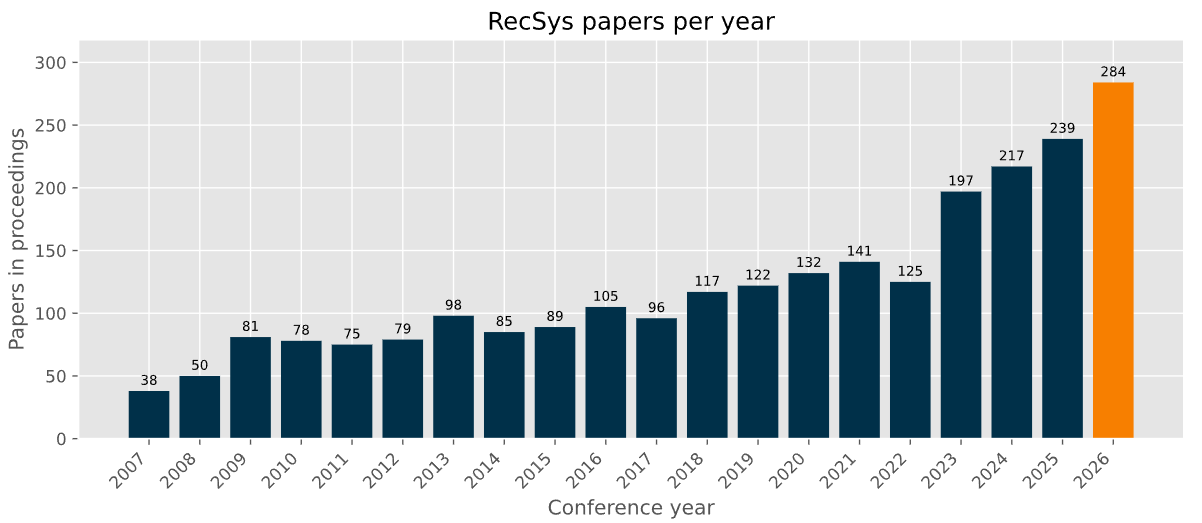
We’re currently at 284 papers published (counted from the citations file), where almost twenty years ago, at the very first edition in 2007, there were only around 38. It has been a steady climb, but there’s a clear acceleration between 2022 and 2026. I suspect that comes from the conference loosening its paper-format rules and opening up more tracks.
That growth also shows up in the author lists: in 2007 a paper had 2.4 authors on average, where in 2026 we’re at around 5.7. The work in recommender systems seems to be getting more collaborative, as the systems get more complex and exploratory.
If we dig a bit deeper and look at the more recent editions, we start to see the split between industry and academia in who’s publishing.
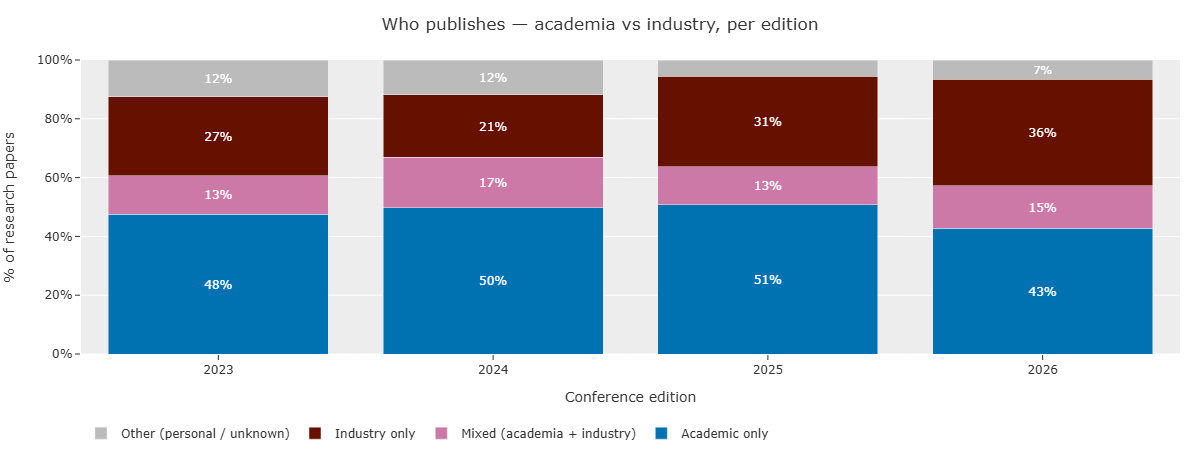
It stays fairly consistent, with roughly half the papers coming from academia, but industry’s share keeps increasing year after year. By 2026, papers with at least one industry author make up about half the edition too. To me that shows the conference is becoming more than pure academic R&D, it’s increasingly about systems that bring real value in industry, where the breakthrough is in actually applying things at scale.
I also compiled the top contributors for each domain into a few charts. You’ll find them in the carousel below, split between academia and industry.
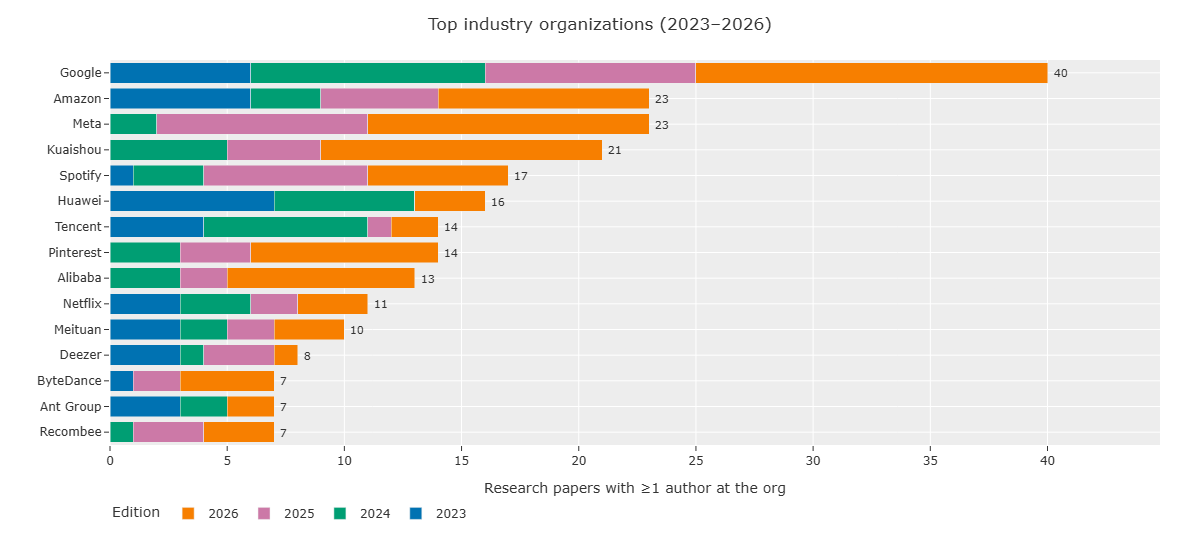
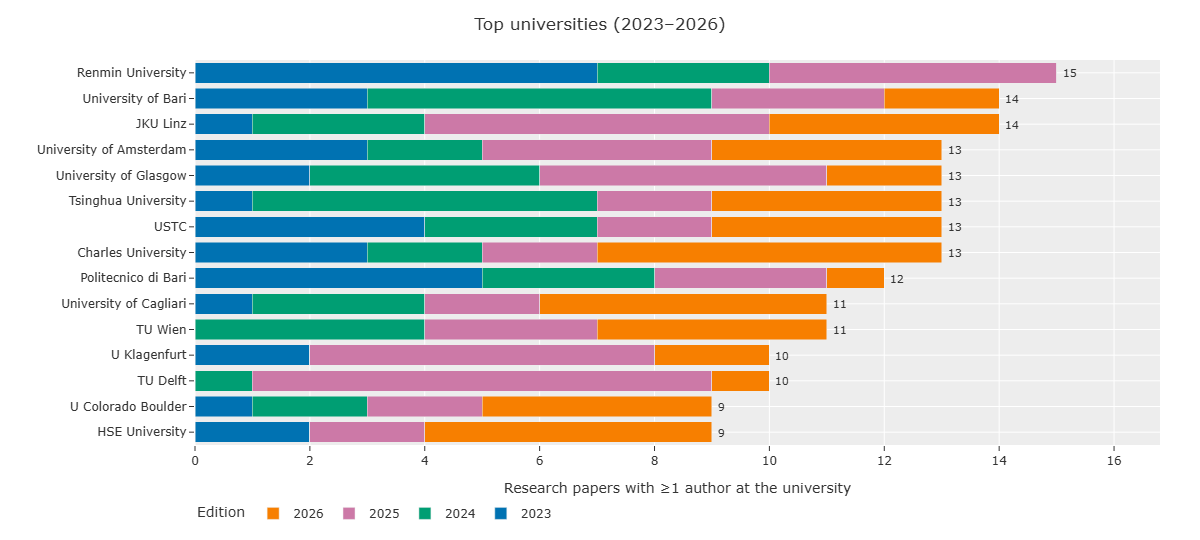
Google clearly stands out as one of the main industry contributors, but as a French person it’s always cool to see a company like Deezer holding its ground just outside the top 10, surrounded by giants like ByteDance and Netflix. On the academic side, the leading university seems to be Renmin (in China), but there’s a strong European contingent right behind it with Bari(s), JKU Linz, Amsterdam and Glasgow.
Overall there’s a diverse crowd talking about recommendation at this conference, and it’s definitely a good place to see where the trends are heading in both domains
Speaking of trends, I worked on analysing the methods mentioned across these papers (using a mix of LLM summarization and keyword extraction), and there’s clearly a shift that happened at the conference, one that follows the broader AI trends we’ve all watched over the past ten years.
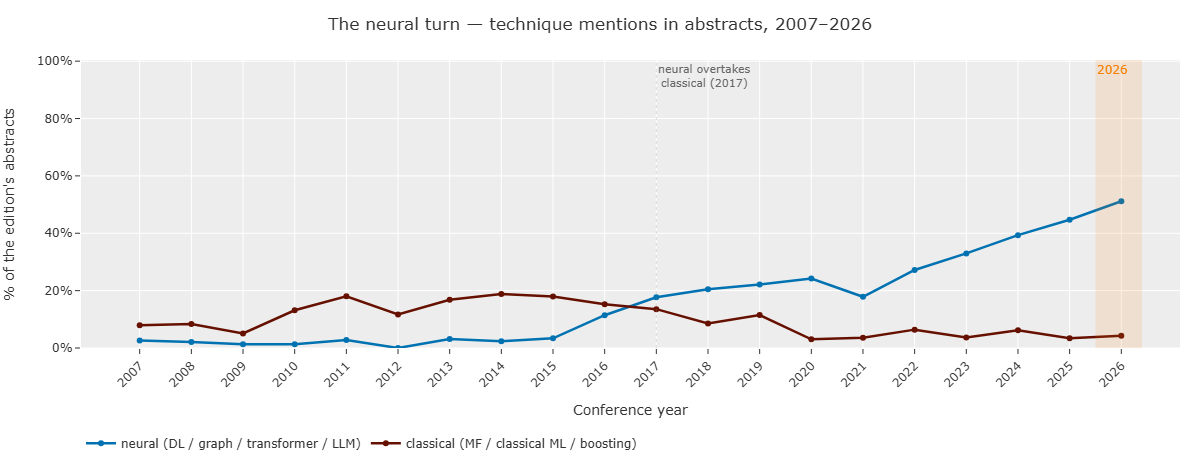
Around 2017 there was a clear turn: the share of papers mentioning neural techniques like deep learning overtook the classical ones, and it has only kept growing since. By 2026, more than half of the abstracts mention a neural method.If take our magnifying glass we can see something more interesting.

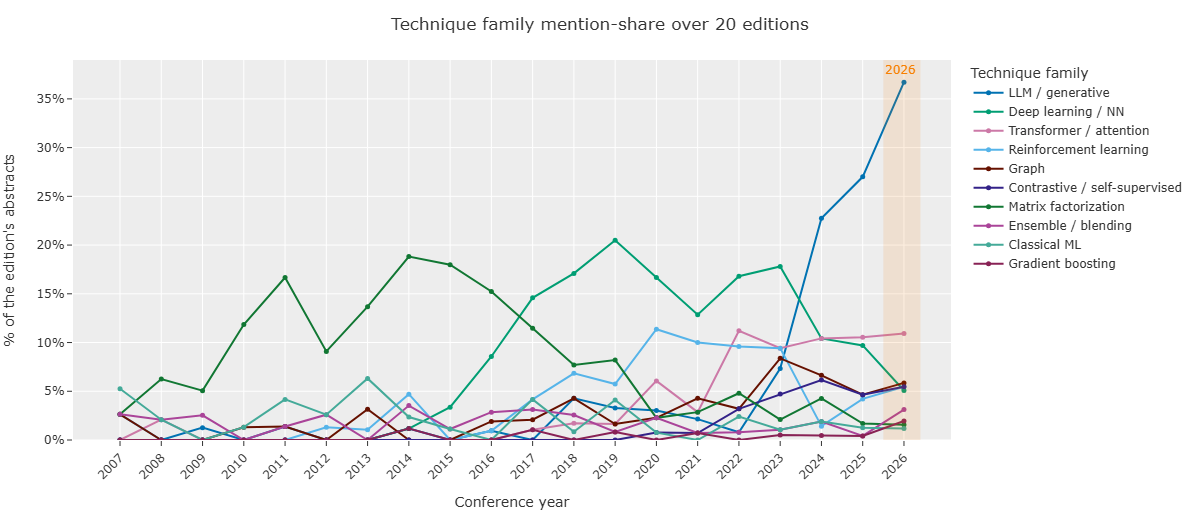
The graph makes the neural shift obvious, but there’s also a clear change of interest since 2023 in the neural field. With LLMs and generative techniques showing up everywhere in our daily lives, that family climbed fast, going from about 7% of abstracts in 2023 to 37% in 2026, which makes it the single most-mentioned family at this year’s conference. If the early 2020s were the transformer years, the second half of the decade looks like the LLM/generative era, as we seeing search and recommendation to blend together since a few years now.
All these charts came out of a side project I’ve been poking at for a while, so let me actually show you the thing.
Recsys conference explorer
Over the past couple of years the format of the conference changed a bit: it’s no longer possible to attend virtually, now that the world has moved on from the covid/remote era. That changed how I consume the conference personally as since 2021 I was attending virtually, analysing talks on the fly and doing recaps as I went. It stayed hybrid until 2024 I think, but 2025 and 2026 were fully in person, so my way of following it had to change (that, plus the fact that I’m a parent now, which makes it a lot harder to stay up all night watching talks and crushing out summaries like in the old days).
In this context, and since 2023, I’ve started downloading all the PDFs from the conference (they’re freely available during the conference period) so I can analyse them afterwards and do my recap more à la carte, whenever I find some time. It’s not quite the same thing: you’re less in “conference mode” watching replays and writing recaps, so it’s a bit less motivating in some ways.
But with all the data I started collecting from the PDFs, plus all the citation metadata that’s freely available and full of interesting information (see the previous section), I wanted to build something beyond simple monitoring, a tool that could be useful to my colleagues at Ubisoft, or to anyone interested in recommender systems who wants to dig into the papers the conference produces.
So I built a Gradio web app hosted on Hugging Face as a RecSys conference explorer, where I expose the citations I collected for every edition, plus the data I extracted with Haiku from all the PDFs I’ve gathered since 2023.
Disclaimers:
- This app is totally experimental and not endorsed by ACM RecSys in any way, so please be indulgent.
- I strongly recommend not using the app embedded in the article, and opening it directly on Hugging Face instead.
The overall idea is to have a tool that gives an overview of the conference’s papers (the list of papers, their authors, abstracts and links), with the ability to search and browse the catalog by meaning, find related papers, see the connections between RecSys papers (shared authors and citations, including the external works they cite), and dig into the organizations behind the papers to see how their presence and interests change over time.
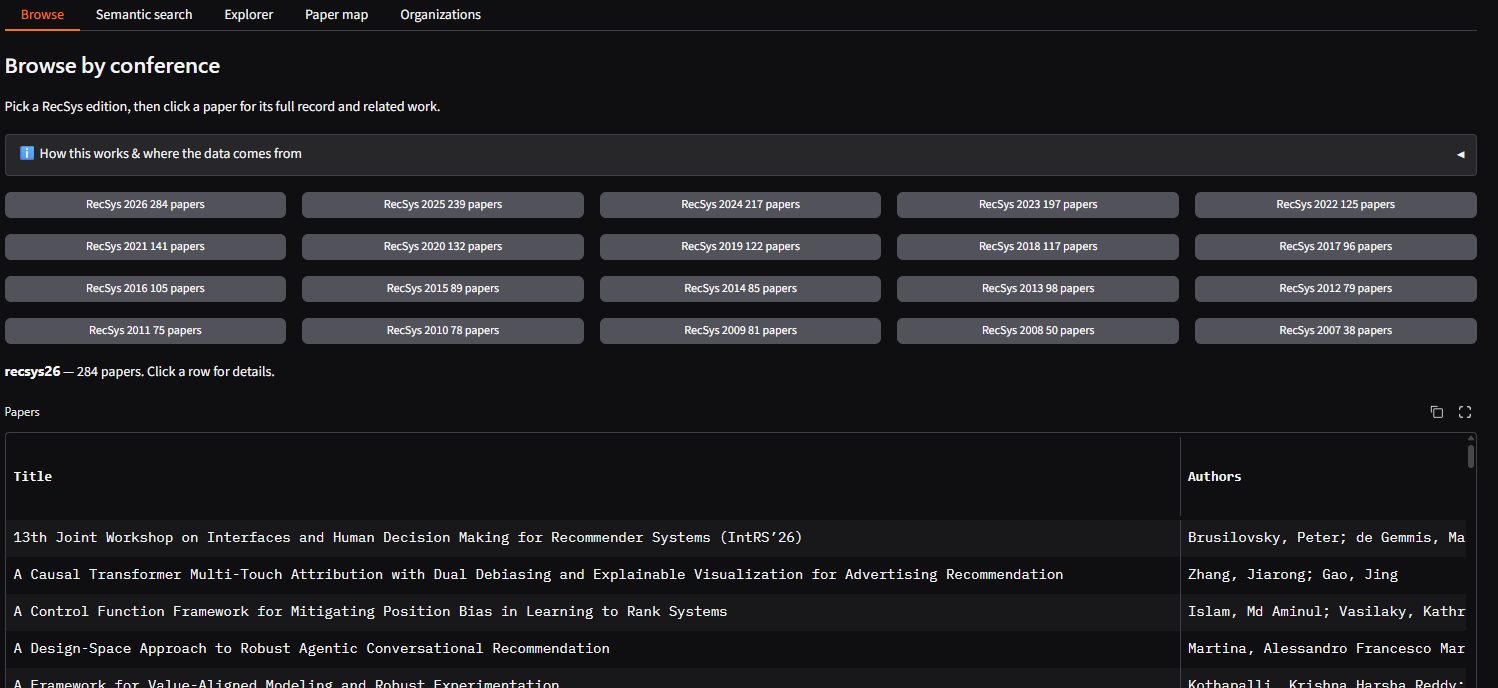
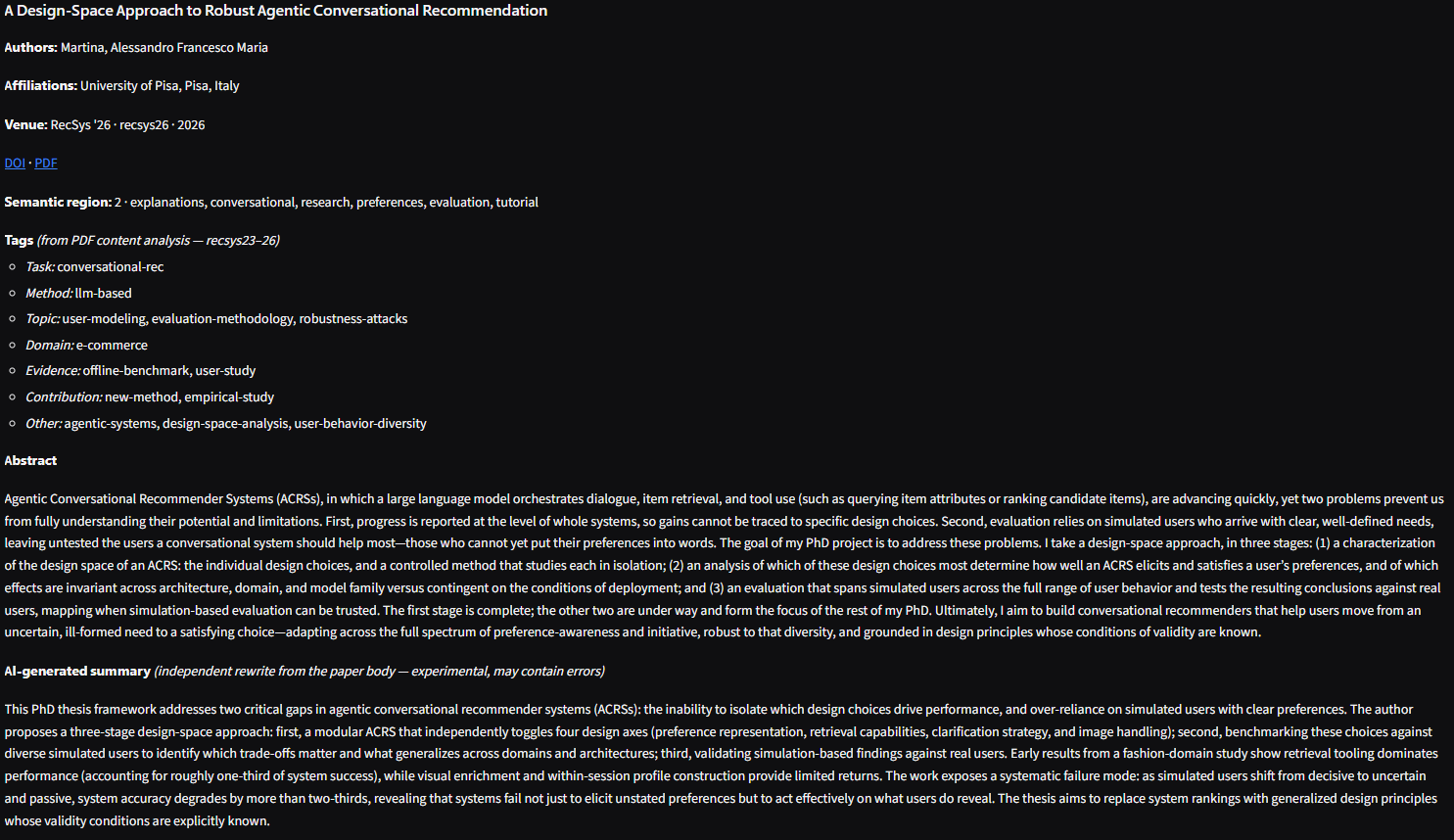
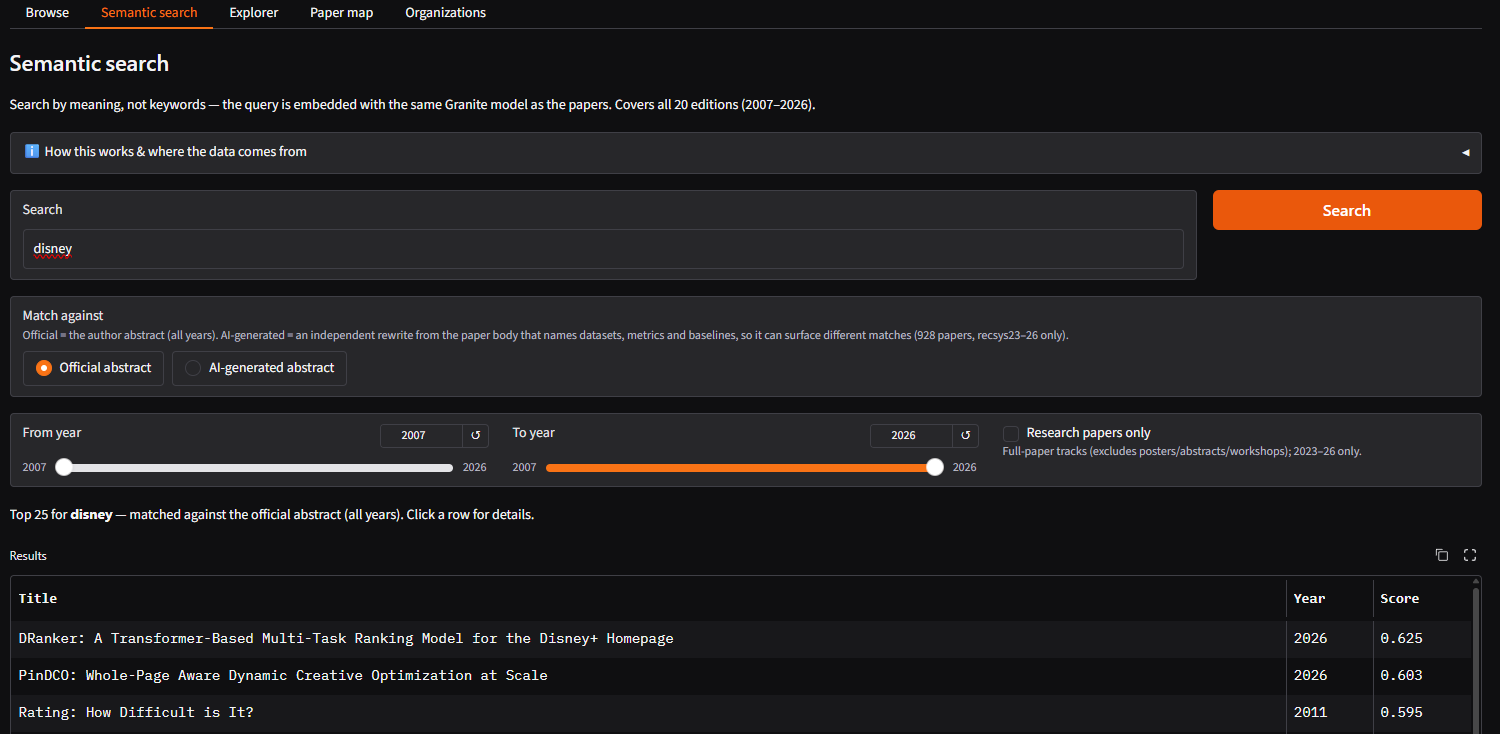
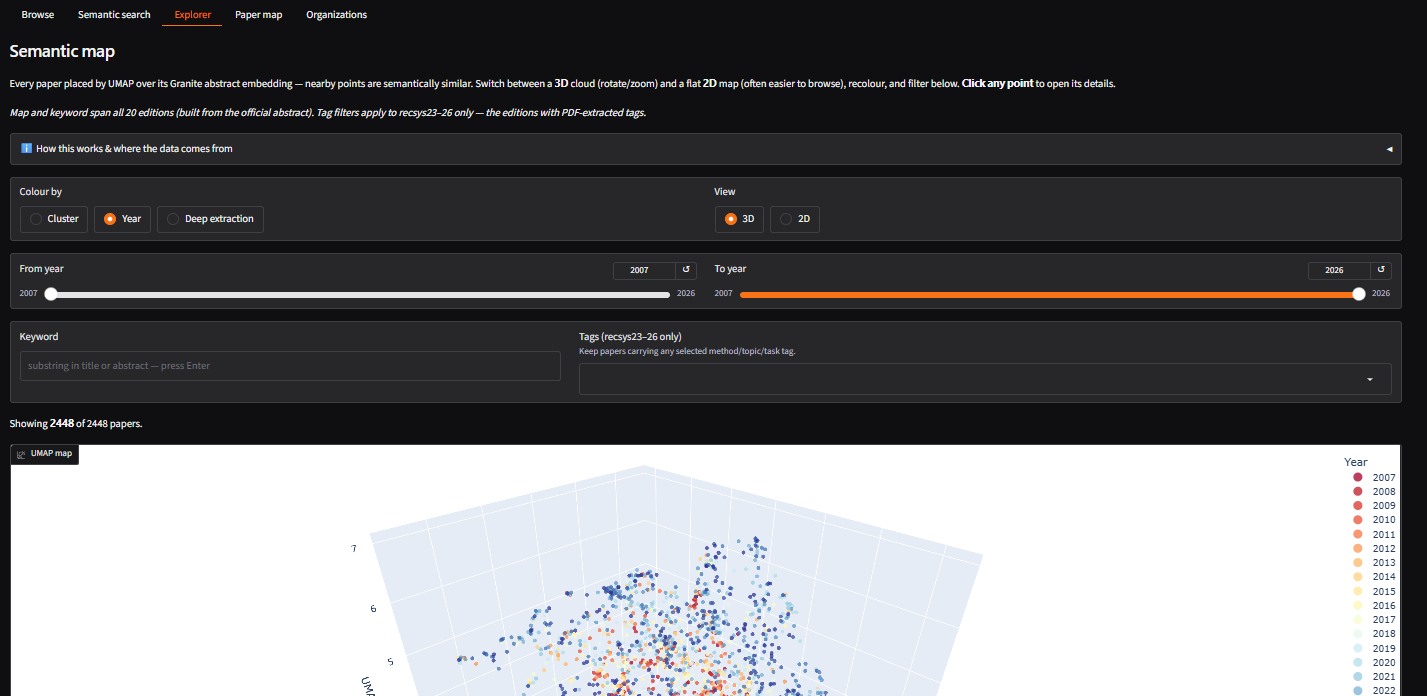
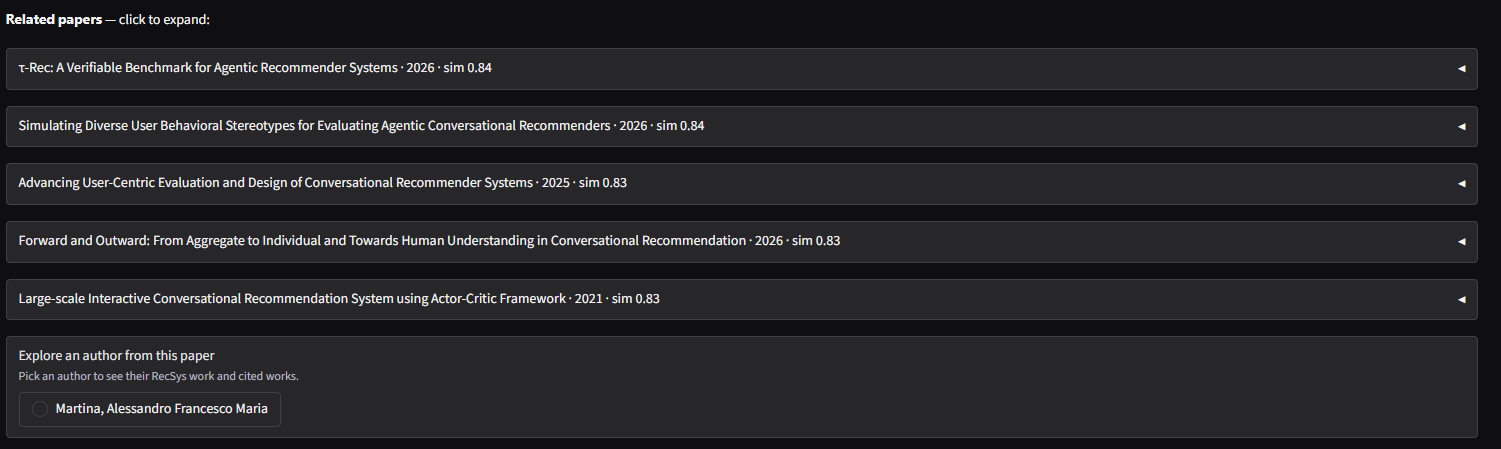
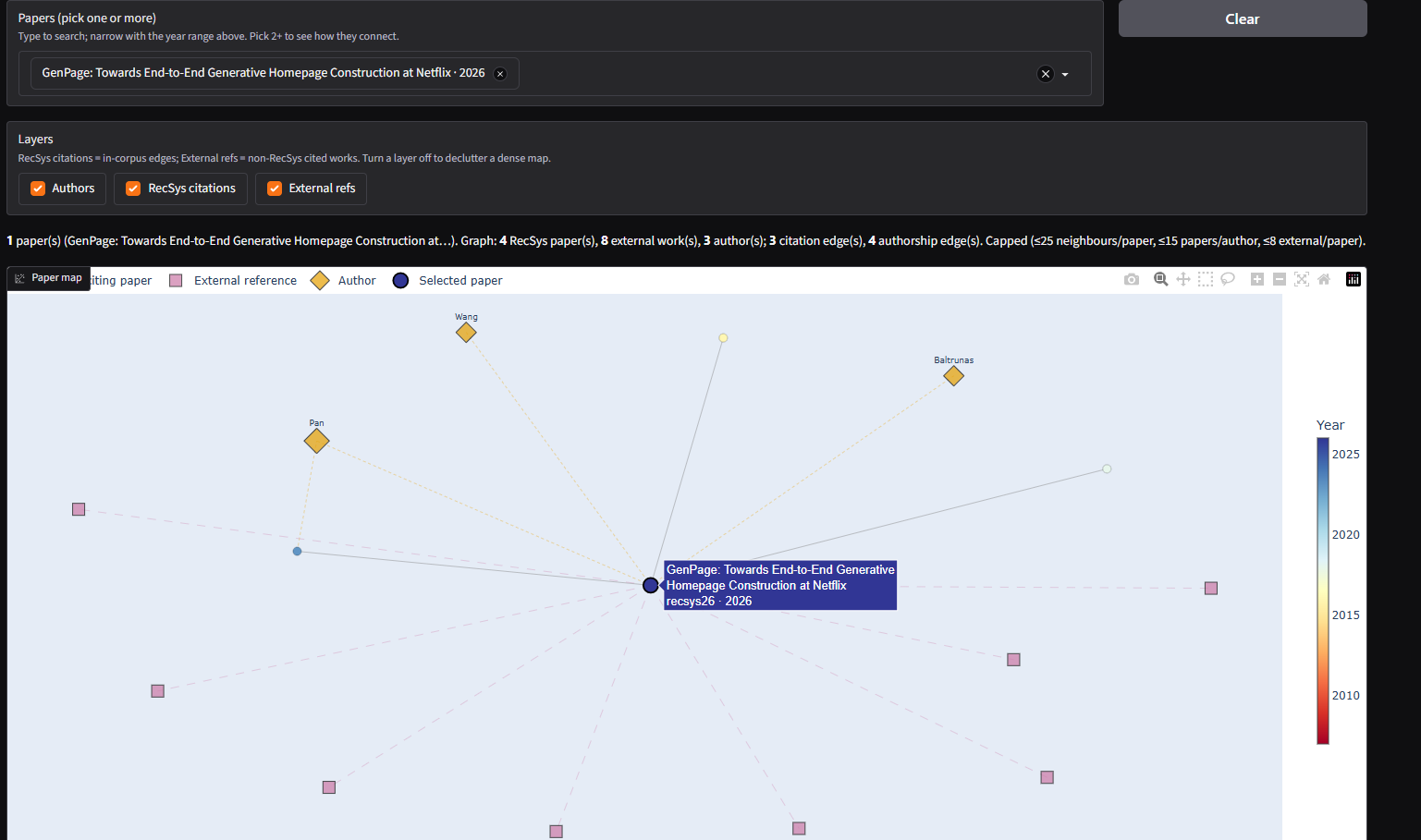
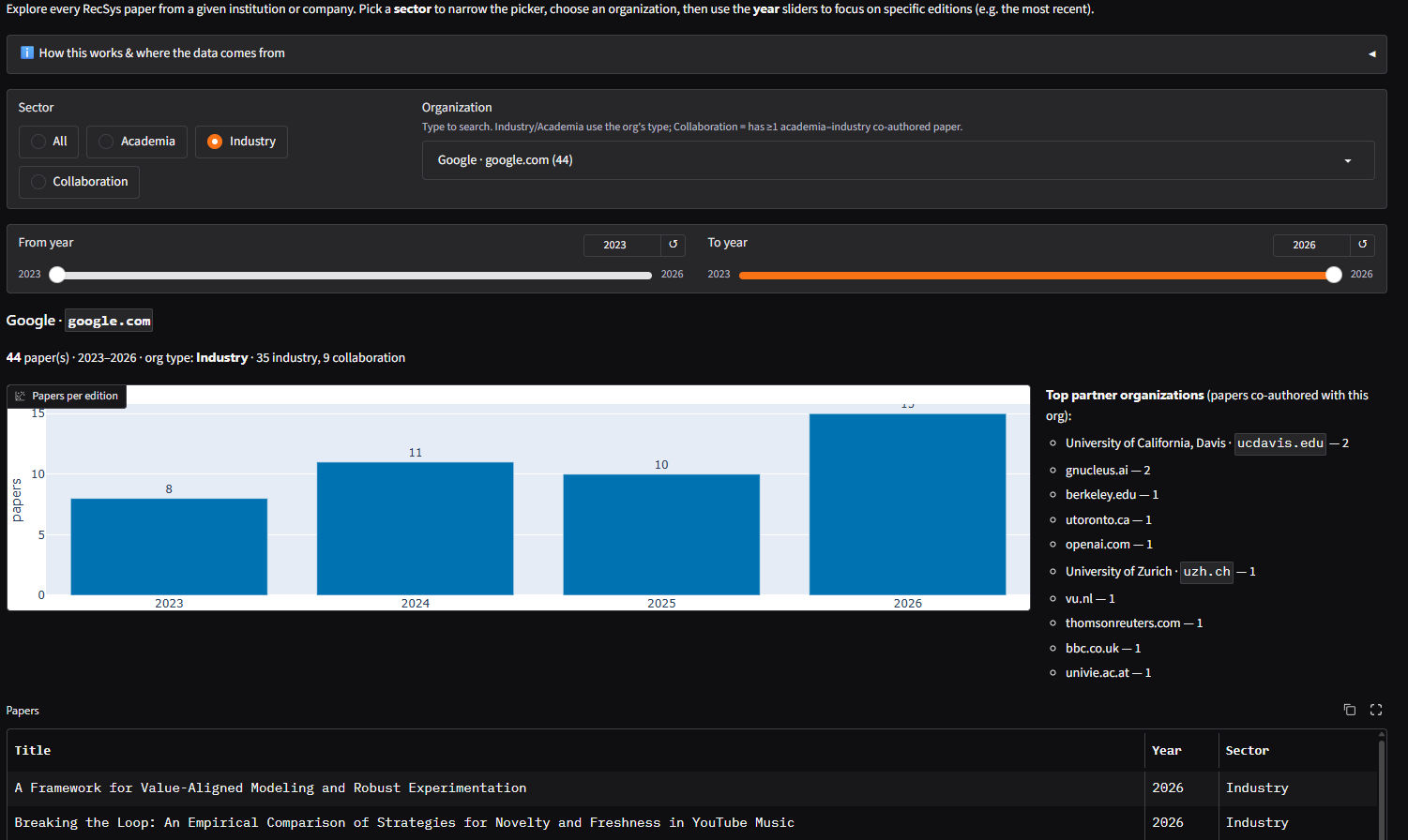
It really helped me dig into this year’s edition and quickly find content aligned with my current interests in recommendation (metadata, retriever/ranker, and LLM/agent usage) in a few clicks with some basic browsing, semantic search, and the organization exploration.
Again, it’s an experiment with Claude and it will keep evolving, so if you want the most up-to-date information on the project you can refer to the README of the app itself. I’m also open to feedback, so don’t hesitate to fill in this Google form. Feedback has already made the app better: thanks to my colleagues who took it for a spin, and a special thanks to Bettina Hein, whose ideas shaped a few of the features I added this week.
So let’s finish with the fun part: my 2026 reading bookmarks.
My reading list
Here’s the condensed version: everything I bookmarked while browsing this year’s edition in the explorer, grouped by theme, one row per paper. Be warned it’s biased towards my current interests (item representations and metadata, retrieval/ranking, and the LLM/agent wave).
LLMs and agents running (most of) the pipeline
| Paper | Org | Focus |
|---|---|---|
| Melo: A Production LLM-Powered Music Recommendation Agent | NetEase Cloud Music | Production music agent |
| RecEvolve: A Knowledge-Driven Autonomous Agent System | Self-evolving architecture search | |
| Personalized Recommendation Tool Learning via Autonomous Language Agents | UIC + Microsoft + Beihang | LLM as model router |
| LLM-Based User Personas for Recommendations at Scale | Google DeepMind | LLM interest personas |
| LLM-Based Re-Ranking for Real Estate Search | QuintoAndar | LLM re-ranker |
| τ-Rec: A Verifiable Benchmark for Agentic Recommender Systems | Princeton + independent | Agentic benchmark |
Generative recommendation and semantic IDs
| Paper | Org | Focus |
|---|---|---|
| GenPage: Towards End-to-End Generative Homepage Construction at Netflix | Netflix | Generative homepage (gave me the same vibe as LinkedIn’s Brew360) |
| TubiFM: Unified Item, Carousel, and Search Ranking | Tubi | Unified LLM ranking |
| Codebook-Based Semantic IDs in Generative Recommendation | HSE University | Semantic IDs (position paper) |
Retrieval, ranking and representations at scale
| Paper | Org | Focus |
|---|---|---|
| Multilingual Semantic Retrieval for Apple Music Search | Apple | Multilingual retrieval |
| End-to-End User and Item Embeddings | Amazon Music | Shared retrieval/ranking embeddings |
| DRanker: A Transformer-Based Multi-Task Ranking Model | Disney | Transformer ranker |
| Personalizing Incremental Video Search with Hybrid Text and ID Embeddings | Apple | Short-prefix search (text + ID) |
| Understanding ID-Text Complementarity in Sequential Recommendation | Snap | ID vs text ensembling |
Discovery, exploration and what counts as a “good” rec
| Paper | Org | Focus |
|---|---|---|
| There’s Something About You: Epistemic Recommendation for Latent Interest Discovery | Disney | Epistemic exploration |
| Music Discovery Quality and the Value of Familiarity | JKU Linz + Deezer | Discovery via familiarity |
| Personalized Fashion Discovery via Session Trajectories and Soft Negatives | TU Wien | Session soft negatives |
Open-source tooling and reproducibility
| Paper | Org | Focus |
|---|---|---|
| Perseus: A Demo of Modular Personalization over Heterogeneous Event Sequences | T-Tech + ITMO | Modular event-sequence framework |
| Scikit-Rank: Scikit-learn-Compatible Neural Ranking Models | T-Tech + HSE | sklearn-style neural ranking |
| scikit-rec: A Unified, Extensible Recommendation Library | Intuit | Unified rec library |
| StreamlitRecommenders: Recommendation Inspectability as a Reproducibility Standard | Charles University + Recombee | Inspectability demos |
| Transformer-based Sequential Recommender Systems | Spotify + Astra | Tutorial |
Closing notes
So that’s a first pass on the RecSys 2026 conference. I took a bit of an alternative road for this year’s recap, but it gave me some new tools to work with and a fresh set of papers to explore, so you can expect a few future articles digging into the papers I selected.
For the more hardcore RecSys aficionados: you’ll have noticed that I set aside the RecSys Challenge and didn’t really mention it. That’s on purpose. I’d like to build a dedicated article or project around it, since the Challenge usually captures some of the most interesting techniques of the moment for solving a specific problem, so I want to take proper time to dig into it.
References
- Recsys 2020 recap — the-odd-dataguy.com
- Briefing — PyPI
- State of RecSys 2026 briefing report — self-hosted (AWS S3)
- RecSys conference explorer (Gradio app) — Hugging Face Spaces
- RecSys conference explorer data — Hugging Face Spaces
- RecSys conference explorer README — Hugging Face Spaces
- Feedback form for the explorer — Google Forms
- LinkedIn’s Brew360 — arXiv
The RecSys 2026 papers from my reading list are not repeated here, you can find their links directly in the tables above.
Citation
If you found this useful, please cite this content as:
Daignan, Jean-Michel. (Oct 2026). ACM RecSys 2026 Recap: Trends, a Paper Explorer & My Reading List. the-odd-dataguy.com. https://www.the-odd-dataguy.com/en/blog/2026/10/07/state-recsys-26/.
or
@article{daignan2026recsys,
  title   = {ACM RecSys 2026 Recap: Trends, a Paper Explorer & My Reading List},
  author  = {Daignan, Jean-Michel},
  journal = {the-odd-dataguy.com},
  year    = {2026},
  month   = {Oct},
  url     = {https://www.the-odd-dataguy.com/en/blog/2026/10/07/state-recsys-26/}
}